Introduction
There is an increasing trend of exposure to ionizing radiation at high doses of total- or partial-body because of radiological/nuclear accidents that can result in prominent health issues [ 1 ]. Exposure of individuals to radiation doses exceeding 1 Gray (Gy) has been demonstrated to lead to severe health consequences. These consequences are typically characterized by pathologies that affect multiple organs throughout the body and are collectively referred to as Acute Radiation Syndrome (ARS) [ 2 ]. This syndrome mostly affects vital organ systems, such as hematopoietic, gastrointestinal, and neurovascular systems; as well as developing multi-organ failure in some patients, leading to their death [ 3 ].
Crucial security issues have emerged by concentrating on radiological preventive measures and medical countermeasures as strategies in the clinical management of ARS. Two major mechanisms were reported for ARS injuries. The first mechanism enrolls direct ionization of target molecules damaging cellular macromolecules, and the second involves interactions with water molecules in the production of free radicals [ 4 ]. Cytokines/growth factors, Nplate (romiplostim), Leukine (sargramostim), Neulasta (PEGylated filgrastim), and Neupogen (filgrastim) were verified for clinical use during a long period [ 5 ]. Herbal medicines have also been utilized with minimal side effects to prevent radiation injuries by improving tissue damage and inhibiting tissue injuries [ 6 ].
Some antioxidants, such as vitamin E or γ‐tocotrienol (γGT3) have been introduced as radioprotective agents for ARS, because members of the vitamin E family were well-defined for their anti-oxidant, anti-inflammatory, and neuroprotective properties [ 7 ]. Even huge resources have been devoted to the development of radioprotective materials; however, serious challenges still exist. Administration of vitamin C (ascorbic acid), a free radical scavenger, was demonstrated to increase survival of mice in ARS models. It is water-soluble and has a free radical-scavenging activity [ 8 ].
Regenerative medicine by application of cell transplantation has opened a new door in the treatment of ARS [ 9, 10 ]. In stem cell therapy, in the laboratory before cell transplantation, the expansion of cells happens. Bone marrow transplantation and cell therapy of peripheral blood and cord blood stem cells have successfully been employed in radiation casualties [ 11 ]. The most clinically approved cell transplantation to date is the use of mesenchymal stem cells (MSCs). Transplantation of MSCs was demonstrated to be beneficial for tissue regeneration. Although the current clinical application of MSCs is limited to diseases other than ARS, their unique biological characteristics, such as migration, homing, self-renewal capacity, multispectral differentiation ability, immunomodulation, anti-inflammatory and minimal host rejection, tissue damage repair, and lack of co-stimulatory molecules have provided their wide use in medicine [ 12 ]. They have been extracted from many tissues including Wharton’s jelly [ 13 ], endometrium [ 14 ], menstrual blood [ 15 ], dental pulp [ 16 ], amniotic fluid [ 17 ], bone marrow [ 18 ], and adipose tissue [ 19 ]. Among different types of MSCs, adipose tissue-derived stem cells (AdSCs) have many advantages making these cells proper candidates for clinical uses, because adipose tissue is available as an abundant source of stem cells, can be prepared via minimally invasive procedures like liposuction and can be easily expanded in cell culture with a significant proliferative capacity [ 20 ]. So our study aimed to assess the role of AdSCs together with vitamin C on the survival of rats with ARS.
Material and Methods
Isolation of adipose-derived stem cells
In this experimental study, to isolate adipose tissue from abdominal and pelvic localities, 4 male rats were anesthetized by a mixture of 2% xylasine (Alfasam, Netherlands) and 10% ketamine (Alfasam, Netherlands), while sacrificed by cervical dislocation. Under the sterile condition, the removed adipose tissues were 3 times washed with phosphate-buffered saline (PBS; Gibco) containing 1% penicillin and streptomycin (Sigma-Aldrich, USA) and further put in falcon tubes containing Dulbecco’s modified Eagle’s medium (DMEM, Gibco, Waltham, USA) and 1% penicillin and streptomycin (Sigma-Aldrich, USA). Then, the adipose tissues were taken out and under a laminar hood were cut into small pieces using a scalpel and were later exposed to 0.2% collagenase Type II at 37 °C on a shaker for 45 min to digest the sample tissues. The falcon containing the digested tissues was driven out and 5 mL of DMEM was subjoined to the content to stop tissue digestion. It was later filtered and the content of the falcon was further spinned at 200 g for 7 min. The supernatant was brought out, and 1 mL of culture media with 88% DMEM, 10% FBS, 1% penicillin-streptomycin, and 1% non-essential amino acids (Sigma-Aldrich, USA) was added to the remained pellet of cells and by using a pipette, cell suspension was provided. The cell suspension was placed in a 25 mL culture flask containing 4 mL of culture media. The culture flask was transferred to a 5% CO2 incubator at 37 °C with saturated humidity, while cell culture media changed every 3 days until reaching cell confluence of 80% confluent culture. To subculture cells until passage 3, the cells in culture flasks were subjected to 0.25% (w/v) trypsin-EDTA (Gibco, USA), while DMEM was added to stop trypsin-EDTA activity before centrifugation and transfer to culture flasks for further passages.
Cell characterization
Morphological characterization was undertaken by an inverted microscope (Nikon, Tokyo, Japan) to show the spindle shape of AdSCs. Several images were provided by a digital camera (Olympus, Tokyo, Japan) to demonstrate their fibroblast-like morphology.
Osteogenic induction was performed for cell characterization. To do so, 6-well plates were used to culture the isolated AdSCs till reaching an 80% cell confluence. Later, osteogenic medium of 50 µM ascorbic acid (Merck, Germany), 100 nM dexamethasone (Sigma Aldrich, USA), and 10 mM glycerol 3-phosohate (Merck, Germany) were added to the complete culture medium containing 15% FBS. The medium was altered every 3 days for 3 weeks. Then to fix the cells, 10% formalin was added, and after 20 min, they were three times washed with deionized water. To confirm osteogenic induction, the cells were stained utilizing 1.4% Alizarin Red solution (solved in deionized water at pH of 4.1, Sigma-Aldrich, USA). If the cells were verified for osteogenic induction, they should appear in red color based on the formation of calcium deposits in the cells and the calcification that happened in the differentiation process.
To characterize AdSC by adipogenic induction properties, the cells were placed in 6-well culture plates containing the culture medium until reaching 80% confluence. Then, media change with adipogenic media containing a complete culture media, 15% FBS, 100 nM dexamethasone, 200 µM indomethacin, and 100 µM ascorbic acid (Sigma Aldrich, USA) happened every 3 days until 21 days. Following 3 weeks of adipogenic media change, AdSCs were fixed in 10% formalin and after 20 min., the cells were 3 times washed with deionized water. To verify adipogenic induction, the cells were further stained employing 0.5% Oil Red-O (Sigma-Aldrich, USA) solved in 2-propanol solution (Merck, Germany) for 2 h, while a positive adipogenic differentiation should appear in red color based on the formation of oil droplets in the differentiated cells.
To characterize the cells molecularly, RT-PCR technique was applied for mesenchymal (CD73 and CD90) and hematopoietic (CD34) markers (Table 1).
| Gene | Primer sequence | Size (bp) |
|---|---|---|
| CD73 | Forward:5’-TGCATCGATATGGCCAGTCC-3’ | 208 |
| Reverse:5’-AATCCATCCCCACC GTTGAC-3’ | ||
| CD90 | Forward:5’-GACCCAGGACGGAGCTATTG-3’ | 177 |
| Reverse:5’-TCATGCTGGATGGGCAAGTT-3’ | ||
| CD34 | Forward:5’-GCCATGTGCTCACACATCA-3’ | 257 |
| Reverse:5’-CAAACACTCGGGCCTAACCT-3’ | ||
| bp: base pair | ||
To evaluate the total RNA, the RNA extraction kit (Cinna Gen Inc., Tehran, Iran) based on the manufacturer’s protocol was employed. The first strand cDNA was collected by use of a Revert Aid™ first strand cDNA synthesis kit (Thermo Fisher Scientific, Waltham, USA). A PCR thermal cycler (Veriti Thermal Cycler, Thermo Fisher Scientific, Waltham, USA) was employed to investigate the PCR runs including 1 cycle at 94 °C for 3 min, 35 cycles at 94 °C for 30 s, 60 °C for 30 s, and 72 °C for 30 s; and 1 cycle at 72 °C for 10 min. Electrophoresis by use of DNA-safe stain in 1.5% agarose gel medium and a gel documentation system (UVtec, Cambridge, UK) was undertaken to test the bands for mesenchymal and hematopoietic markers.
Animals and grouping
Forty-five male Wistar rats (weighing=250-300 g) were purchased from Laboratory Animal Center of Shiraz University of Medical Sciences and acclimatized to laboratory conditions before interventions (23 ℃, 12 h/12 h light/dark, access to food and water ad libitum). Rats were sacrificed according to instructions of regulations and laws complied with the ARRIVE guidelines and the Declaration of Helsinki and Iran Veterinary Organization for laboratory animals to minimize pain or discomfort to the animals.
The enrolled rats in the study were randomly divided into 3 equal groups of animals administered with just a single dose of 400 mg/kg vitamin C orally, those intravenously injected into the tail with 1.5×10⁵ AdSCs of passage 4 in 150 µL medium, and rats injected intravenously into the tail with 1.5×10⁵ AdSCs of passage 4 in 150 µL medium together with a single dose of 400 mg/kg vitamin C orally. The three groups were already irradiated with 10 Gy (dose rate 0.286 Gy/ min) 60CO, for 35 minutes with a field size of 35×35 for all the body area [ 16 , 17 ]. The survival rate in each group was investigated after 48 hours and 30 days.
Statistical analysis
To compare the groups, SPSS software (Version 21, Chicago, IL, USA) was utilized by Kaplan-Meier analysis. A P-value less than 0.05 was defined as statistically significant.
Results
Cell characterization
AdSCs expressed mesenchymal surface markers of CD73 and CD90 (Figure 1A) and lacked CD34 as a surface marker of hematopoietic stem cells (Figure 1B). AdSCs were shown to appear plastic adherent and fibroblast-like morphology (Figure 1C). Osteogenic induction was positive for AdSCs with the presence of calcium deposits in red color in the cells when staining was undertaken with Alizarin red (Figure 1D). AdSCs were positive for adipogenic induction based on the presence of oil droplets in the cells after staining with Oil Red O (Figure 1E).
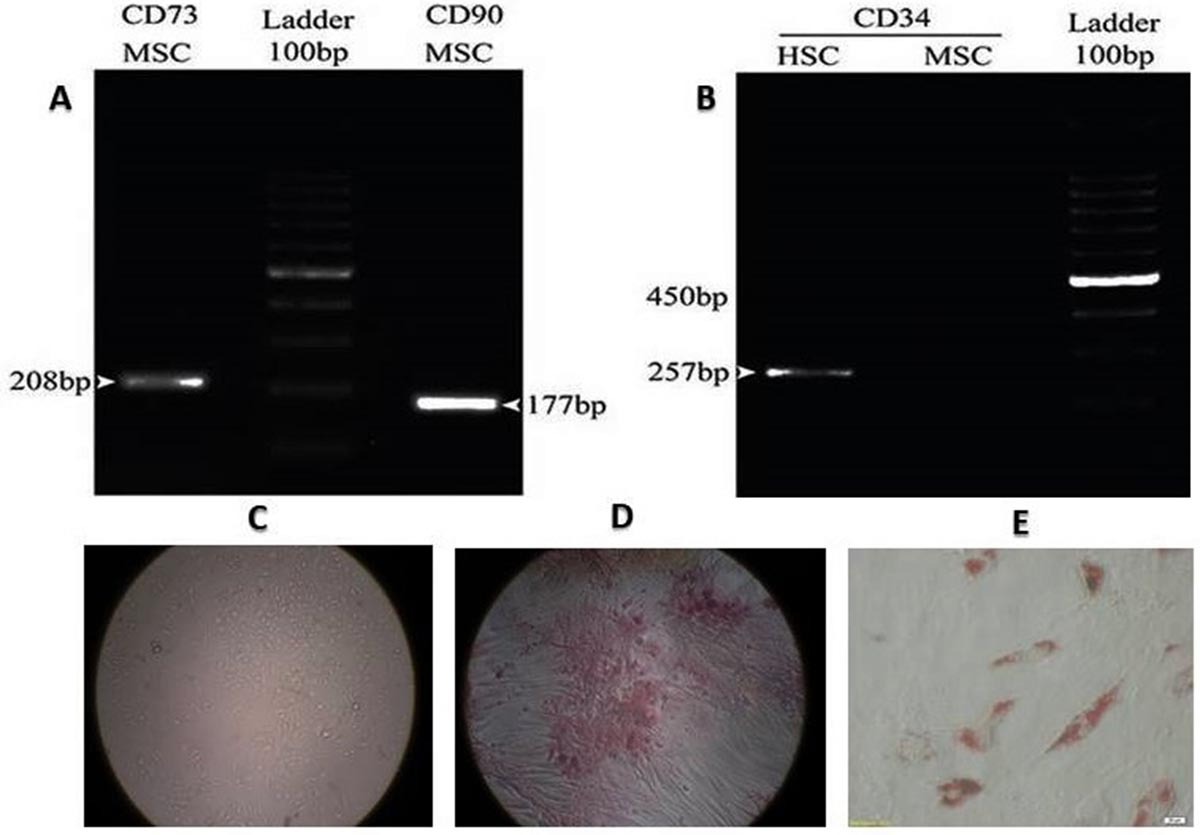
Figure 1. Cell characterization. A. By RT-PCR showing positive expression of CD73 and CD90 as mesenchymal surface markers. B. By RT-PCR exhibiting negative expression of CD34 as a hematopoietic surface marker. C. By morphology from passage 3 to be spindle shape (20x). D. Positive osteogenic differentiations of AdSCs by Alizarin Red staining revealing calcium deposits in the cells (20x). E. Positive adipogenic induction of AdSCs by Oil Red staining denoting to presence of oil droplets in the cells (20x). (RT-PCR: Reverse Transcription Polymerase Chain Reaction, AdSCs: Adipose Tissue Derived Stem Cells, MSC: Mesenchymal Stem Cell; HSC: Hematopoietic Stem Cell)
Animal grouping
The survival rate significantly increased one month after γ irradiation among 73.3% of animals received AdSCs+vitamin C, 60% of rats injected with just AdSCs, and 13.3% of the group received just vitamin C (P=0.006, Table 2). The survival rate significantly increased after exposure of the whole body to 10 Gy γ irradiation and then transplantation of AdSCs together with vitamin C when compared to other groups measured by the Kaplan-Meier test (P=0.001). In addition, 48 hours after irradiation, a single injection of AdSCs could significantly increase the survival rate when compared to the control group (P=0.01, Figure 2).
| Group | Animals (n=45) | ||
|---|---|---|---|
| Total (No.) | Survived (No.) | Survived (%) | |
| Vitamin C | 15 | 2 | 13.3 |
| AdSCs | 15 | 9 | 60.0 |
| AdSCs+Vitamin C | 15 | 11 | 73.3 |
| AdSCs: Adipose Tissue-Derived Stem Cells | |||
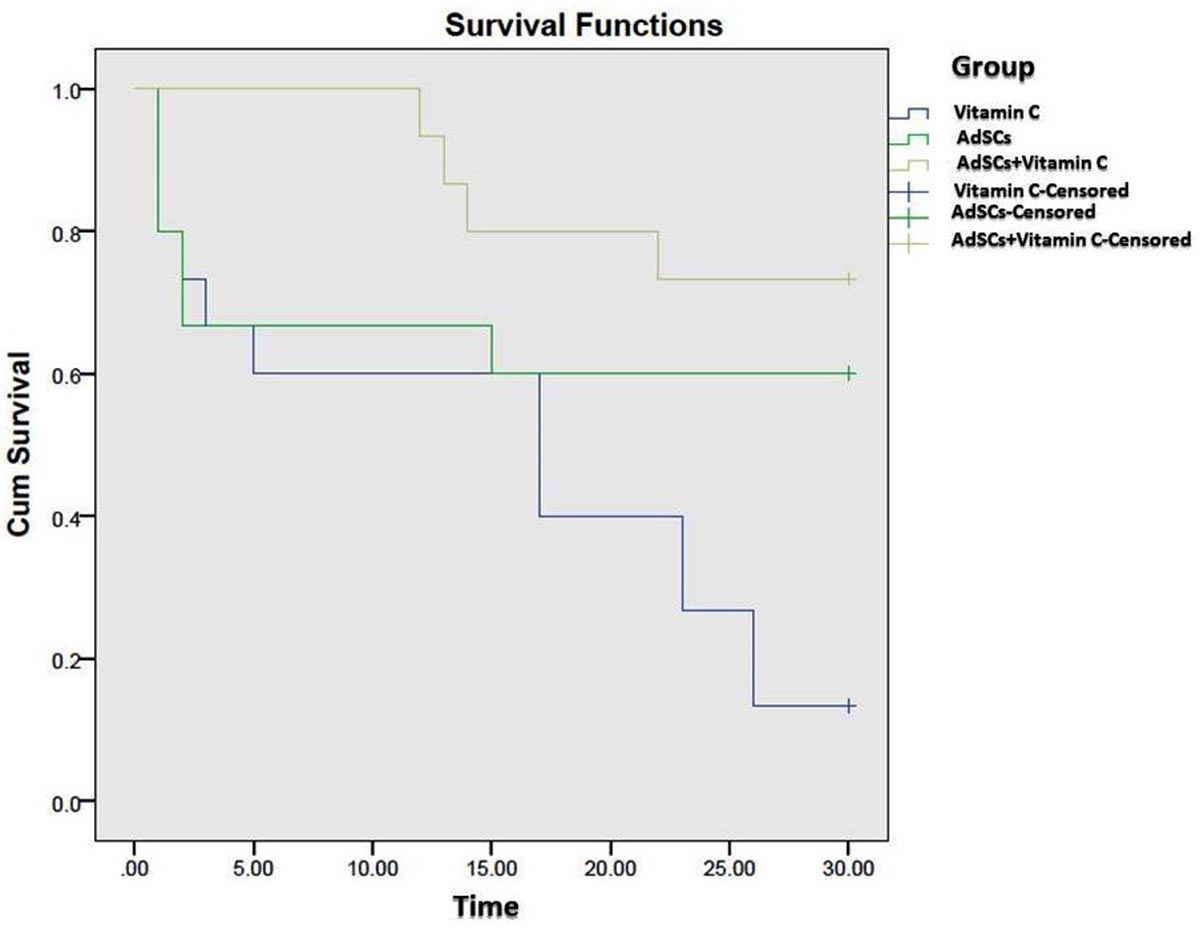
Figure 2. Comparison of animals administered with just a single dose of 400 mg/kg vitamin C orally, those received an intravenous injection of 1.5×10⁵ AdSCs (Adipose Tissue-Derived Stem Cells) into the tail, and rats intravenously injected with 1.5×10⁵ AdSCs into the tail together with oral administration of a single dose of 400 mg/kg vitamin C. The three groups were already irradiated with 10 Gy (dose rate 0.286 Gy/ min) 60CO, during 35 minutes with a field size of 35×35 for the body area.
Discussion
ARS is a clinical syndrome that can involve several organ systems and lead to gastrointestinal subsyndrome (GIS, >6 Gy), cutaneous subsyndrome (CS, >25 Gy), neurovascular subsyndrome (NVS, >10 Gy), and hematopoietic syndrome (HS, 2-6 Gy). Radiation exposure in ARS can happen internally and/or externally through many pathways [ 21 ]. All healthcare centers are responsible for helping injured individuals in radiation accidents. Recommendations are made based on radiation dose and physiologic response in the treatment of ARS including blood transfusion; hematopoietic cytokines and stem-cell transplantation [ 22 ]. AdSCs are characterized by their spindle shape morphology being positive for mesenchymal markers and lacking hematopoietic markers with immunomodulating and anti-inflammatory properties [ 14 ]. Our findings denoted spindle shape morphology, positive expression of mesenchymal markers, and lack of hematopoietic markers of AdSCs too [ 14 ].
MSC transplantation was demonstrated to be beneficial in ARS therapy based on the immunomodulatory properties of MSCs [ 23 ]. Chapel et al. denoted the role of MSCs to home the injured region and remedy a radiation-induced multi-organ failure syndrome [ 24 ]. Bone marrow-derived stem cells (BMSCs) transplantation together with HLA-mismatched peripheral blood stem cells in a Chinese patient exposed to a dose of 14.5 GY γ- radiation in the whole body has been effective in reducing mortality rate and successfully rescuing hematopoietic damages [ 25 ]. Successful systemic injection of BMSCs has been reported in the treatment of ARS-induced mice displaying improved regenerative features characterized by declined proinflammatory cytokines, ECM formation, and adhesion properties and boosted anti-inflammation, detoxification, cell cycle, and anti-oxidative stress control [ 26 ]. Allogeneic BMSCs transplantation in mice treated with lethal total body irradiation was exhibited to attenuate radiation-induced hematopoietic toxicity and to provide immunoprotection by alleviating regulating T cell chemokine receptor expressions, expanding Tregs, lymphocyte-mediated CFU-GM inhibition, and skewing the Th1/Th2 balance toward anti-inflammatory Th2 polarization [ 27 ]. In mice model of ARS irradiated with 10 Gy (dose rate 0.286 Gy/min) 60CO, during 35 minutes with a field size of 35×35 for all the body area, BMSCs were exhibited to decline the significant impacts of radiation in ARS and to increase the survival rate [ 9, 10 ].
Also, impressive influences of intramuscular injections of AdSCs after acute local irradiation with 50 Gy gamma rays in minipigs were displayed to lead to a polarization of M2 in the inflammatory response to direct the irradiated tissues’ inflammatory response towards a pro-regenerative outcome [ 28 , 29 ]. Akita et al. noticed an efficient improved fat angiogenesis, architected dermal reconstitution, and less inflammatory epidermal recovery in cutaneous ARS after transplantation of MSCs [ 30 ]. Immunohistological analysis of cytokeratin expression has denoted to a complete epidermis recovery in pigs locally gamma irradiated by 60Co source at the dose of 50 Gy after transplantation of AdSCs at the dermis/subcutis [ 31 ]. Identically, we showed a significant increase in survival rate after γ irradiation in animals received AdSCs, while this increase was greater when AdSCs were administered in combination with vitamin C when compared to those received just vitamin C after γ irradiation.
Administration of vitamin C, a free radical scavenger, was shown to increase the survival of mice in ARS models and nutritionally sufficient vitamin C can exert a radioprotective effect against ARS [ 32 ]. The data suggest that after high-dose vitamin C, the radiation dose given to cancer patients could be increased in the absence of any increase in acute complications [ 33 ]. The combination of BMSCs and treatment with oral vitamin C was demonstrated to rescue mice receiving a higher dose of total body irradiation by inhibiting GIS [ 34 ]. Our findings have also indicated an increased survival rate when vitamin C was administered in mice models of ARS. The novelty of our study was the combination of vitamin C with AdSCs in the treatment of ARS revealing a greater rise in the survival rate of mice with ARS when compared to vitamin C or ADSCs administered alone. The radioprotective effect of vitamin C can be attributed to its interaction with radiation-induced free radicals, effective prevention of cell apoptosis [ 35 ], and protection against DNA damage created by ionizing radiation [ 36 ].
Conclusion
Our findings present evidence for this highly effective impact of the combination of stem cell transplantation and vitamin C to increase survival rate after lethal irradiation in rats. So this combination may open a window when alleviation of injured tissues due to chemotherapy and toxic drug reaction is targeted and we recommend injection of AdSCs together with vitamin C as an impressive and instant therapy of choice after irradiation injuries; because AdSCs are easily available, are massively expanded, can be saved for prolonged time, and can be easily dispensed to places in need.
Acknowledgment
We appreciate the kind support of the National Institute for Medical Research Development of Iran Ministry of Health, Treatment and Education for financial support, and Ionizing and Non-Ionizing Radiation Protection Research Center, and the Stem Cell Technology Research Center of Shiraz University of Medical Sciences, Shiraz, Iran for providing spaces to undertake the study.
Authors’ Contribution
SMJ. Mortazavi, F. Shekoohi Shooli, and D. Mehrabani were involved in conceptualization, methodology, software design, validation, and writing the paper. F. Kadivar, S. Masoudi, and A. Kanani participated in data collection, labeling, and checking the labels. SMJ. Mortazavi, F. Shekoohi Shooli and MA. Mosleh-Shirazi were involved in the induction of ARS. SMJ. Mortazavi, D. Mehrabani, and F. Karimi-Busheri were involved in the supervision, investigation, and editing of the manuscript. S. Zare, D. Mehrabani, and F. Shekoohi Shooli were involved in stem cell technology. All authors read the final version of the manuscript and approved it.
Ethical Approval
The study was ethically approved by the National Institute for Medical Research Development of Iran Ministry of Health, Treatment and Education (No. 963474) and followed the tenets of the Declaration of Helsinki.
Informed Consent
This is an animal study and no informed consent was necessary.
Conflict of Interest
SMJ. Mortazavi, as the Editorial Board Member, was not involved in the peer-review and decision-making processes for this manuscript.
References
- Singh VK, Seed TM. Development of gamma-tocotrienol as a radiation medical countermeasure for the acute radiation syndrome: current status and future perspectives. Expert Opin Investig Drugs. 2023; 32(1):25-35. DOI | PubMed
- Zuziak P, Bielaska A. Acute radiation syndrome. J Educ Health Sport. 2023; 36(1):49-60. DOI
- Feldman RJ, Kazzi Z, Walter FG. Radiation Injuries: Acute Radiation Syndrome in Children. Pediatr Ann. 2023; 52(6):e231-7. DOI | PubMed
- Libero M. Development of Drug Products for the Treatment of Acute Radiation Syndrome. Disaster Med Public Health Prep. 2024; 17:e571. DOI | PubMed
- World Health Organization. National stockpiles for radiological and nuclear emergencies: policy advice. WHO; 2023.
- Zhang X, Chen X, Wang L, He C, Shi Z, Fu Q, et al. Review of the Efficacy and Mechanisms of Traditional Chinese Medicines as a Therapeutic Option for Ionizing Radiation Induced Damage. Front Pharmacol. 2021; 12:617559. Publisher Full Text | DOI | PubMed [ PMC Free Article ]
- Garg S, Garg TK, Wise SY, Fatanmi OO, Miousse IR, Savenka AV, et al. Effects of Gamma-Tocotrienol on Intestinal Injury in a GI-Specific Acute Radiation Syndrome Model in Nonhuman Primate. Int J Mol Sci. 2022; 23(9):4643. Publisher Full Text | DOI | PubMed [ PMC Free Article ]
- Sihver L, Mortazavi SMJ. Biological Protection in Deep Space Missions. J Biomed Phys Eng. 2021; 11(6):663-74. Publisher Full Text | DOI | PubMed [ PMC Free Article ]
- Aghamir SM, Mehrabani D, Amini M, Mosleh-Shirazi MA, Nematolahi S, Shekoohi-Shooli F, et al. The Regenerative Effect of Bone Marrow-Derived Stem Cells on Cell Count and Survival in Acute Radiation Syndrome. World J Plast Surg. 2017; 6(1):111-3. Publisher Full Text | PubMed [ PMC Free Article ]
- Mortazavi SMJ, Shekoohi-Shooli F, Aghamir SM, Mehrabani D, Dehghanian A, Zare S, Mosleh-Shirazi MA. The healing effect of bone marrow-derived stem cells in acute radiation syndrome. Pak J Med Sci. 2016; 32(3):646-51. Publisher Full Text | DOI | PubMed [ PMC Free Article ]
- Fukumoto R. Mesenchymal stem cell therapy for acute radiation syndrome. Mil Med Res. 2016; 3:17. Publisher Full Text | DOI | PubMed [ PMC Free Article ]
- Rahmanifar F, Tamadon A, Mehrabani D, Zare S, Abasi S, Keshavarz S, et al. Histomorphometric evaluation of treatment of rat azoosper-mic seminiferous tubules by allotransplantation of bone marrow-derived mesenchymal stem cells. Iran J Basic Med Sci. 2016; 19(6):653-61. Publisher Full Text | PubMed [ PMC Free Article ]
- Mohammdzadeh N, Mehrabani D, Zare S, Masoumi SS, Rasouli-Nia A, Karimi-Busheri F. What Happens When Methamphetamine Is Added to Nutrients of Cell Culture Medium? In Vitro Assessment of Morphological, Growth and Differential Potential of Wharton’s Jelly Stem Cells. Int J Nutr Sci. 2022; 7(4):233-40. DOI
- Mehrabani D, Rahmanifar F, Mellinejad M, Tamadon A, Dianatpour M, Zare S, Jahromi IR, Ghobadi F. Isolation, culture, characterization, and adipogenic differentiation of heifer endometrial mesenchymal stem cells. Comp Clin Pathol. 2015; 24:1159-64. DOI
- Fard M, Akhavan-Tavakoli M, Khanjani S, Zare S, Edalatkhah H, Arasteh S, et al. Bilayer Amniotic Membrane/Nano-fibrous Fibroin Scaffold Promotes Differentiation Capability of Menstrual Blood Stem Cells into Keratinocyte-Like Cells. Mol Biotechnol. 2018; 60(2):100-10. DOI | PubMed
- Mehrabani D, Mahdiyar P, Torabi K, Robati R, Zare S, Dianatpour M, Tamadon A. Growth kinetics and characterization of human dental pulp stem cells: Comparison between third molar and first premolar teeth. J Clin Exp Dent. 2017; 9(2):e172-7. Publisher Full Text | DOI | PubMed [ PMC Free Article ]
- Borzou B, Mehrabani D, Zare S, Zamani-Pereshkaft M, Acker JP. The Effect of Age and Type of Media on Growth Kinetics of Human Amniotic Fluid Stem Cells. Biopreserv Biobank. 2020; 18(5):389-94. DOI | PubMed
- Rasekh H, Hoseini Farahi M, Mehrabani D, Massoumi SJ, Ramzi M, Acker JP. Proliferative and Regenerative Effect of Acetonic Extract of Feijoa sellowiana on Stem Cells. World J Plast Surg. 2020; 9(3):313-20. Publisher Full Text | DOI | PubMed [ PMC Free Article ]
- Mehrabani D, Arshi S, Sadeghi L, Khodabandeh Z, Zare S, Rasouli-Nia A, Karimi-Busheri F. Regenerative Impact of Adipose Tissue Originated Stem Cells on Healing of Liver Injuries: Biochemical Assay and Histological Examination. Medliber Regener Med. 2023; 1(1):1-8. DOI
- Mehrabani D, Arshi S, Sadeghi L, Khodabandeh Z, Zare S, Rabiee M. The Ameliorating Effect of Adipose Tissue Stem Cells on Liver Function in Experimental Rats with Liver Fibrosis. Int J Nutr Sci. 2022; 7(4):225-32. DOI
- Guan B, Li D, Meng A. Development of radiation countermeasure agents for acute radiation syndromes. Animal Model Exp Med. 2023; 6(4):329-36. Publisher Full Text | DOI | PubMed [ PMC Free Article ]
- Waselenko JK, MacVittie TJ, Blakely WF, Pesik N, Wiley AL, Dickerson WE, et al. Medical management of the acute radiation syndrome: recommendations of the Strategic National Stockpile Radiation Working Group. Ann Intern Med. 2004; 140(12):1037-51. DOI | PubMed
- Eaton EB Jr, Varney TR. Mesenchymal stem cell therapy for acute radiation syndrome: innovative medical approaches in military medicine. Mil Med Res. 2015; 2:2. Publisher Full Text | DOI | PubMed [ PMC Free Article ]
- Chapel A, Bertho JM, Bensidhoum M, Fouillard L, Young RG, Frick J, et al. Mesenchymal stem cells home to injured tissues when co-infused with hematopoietic cells to treat a radiation-induced multi-organ failure syndrome. J Gene Med. 2003; 5(12):1028-38. DOI | PubMed
- Guo M, Dong Z, Qiao J, Yu C, Sun Q, Hu K, et al. Severe acute radiation syndrome: treatment of a lethally 60Co-source irradiated accident victim in China with HLA-mismatched peripheral blood stem cell transplantation and mesenchymal stem cells. J Radiat Res. 2014; 55(2):205-9. Publisher Full Text | DOI | PubMed [ PMC Free Article ]
- Lange C, Brunswig-Spickenheier B, Cappallo-Obermann H, Eggert K, Gehling UM, Rudolph C, et al. Radiation rescue: mesenchymal stromal cells protect from lethal irradiation. PLoS One. 2011; 6(1):e14486. Publisher Full Text | DOI | PubMed [ PMC Free Article ]
- Qiao S, Ren H, Shi Y, Liu W. Allogeneic compact bone-derived mesenchymal stem cell transplantation increases survival of mice exposed to lethal total body irradiation: a potential immunological mechanism. Chin Med J (Engl). 2014; 127(3):475-82. PubMed
- Riccobono D, Nikovics K, François S, Favier AL, Jullien N, Schrock G, et al. First Insights Into the M2 Inflammatory Response After Adipose-Tissue-Derived Stem Cell Injections in Radiation-Injured Muscles. Health Phys. 2018; 115(1):37-48. DOI | PubMed
- Riccobono D, Agay D, François S, Scherthan H, Drouet M, Forcheron F. Contribution of INTRAMUSCULAR Autologous Adipose Tissue-Derived Stem Cell Injections to Treat Cutaneous Radiation Syndrome: Preliminary Results. Health Phys. 2016; 111(2):117-26. DOI | PubMed
- Akita S, Akino K, Hirano A, Ohtsuru A, Yamashita S. Mesenchymal stem cell therapy for cutaneous radiation syndrome. Health Phys. 2010; 98(6):858-62. DOI | PubMed
- Forcheron F, Agay D, Scherthan H, Riccobono D, Herodin F, Meineke V, Drouet M. Autologous adipocyte derived stem cells favour healing in a minipig model of cutaneous radiation syndrome. PLoS One. 2012; 7(2):e31694. Publisher Full Text | DOI | PubMed [ PMC Free Article ]
- Saga R, Uchida T, Takino Y, Kondo Y, Kobayashi H, Kinoshita M, et al. Radiation-induced gastrointestinal syndrome is exacerbated in vitamin C-insufficient SMP30/GNL knockout mice. Nutrition. 2021; 81:110931. DOI | PubMed
- Okunieff P. Interactions between ascorbic acid and the radiation of bone marrow, skin, and tumor. Am J Clin Nutr. 1991; 54(6 Suppl):1281S-1283S. DOI | PubMed
- Yamamoto T, Kinoshita M, Shinomiya N, Hiroi S, Sugasawa H, Matsushita Y, et al. Pretreatment with ascorbic acid prevents lethal gastrointestinal syndrome in mice receiving a massive amount of radiation. J Radiat Res. 2010; 51(2):145-56. DOI | PubMed
- Harapanhalli RS, Yaghmai V, Giuliani D, Howell RW, Rao DV. Antioxidant effects of vitamin C in mice following X-irradiation. Res Commun Mol Pathol Pharmacol. 1996; 94(3):271-87. PubMed
- Cai L, Koropatnick J, Cherian MG. Roles of vitamin C in radiation-induced DNA damage in presence and absence of copper. Chem Biol Interact. 2001; 137(1):75-88. DOI | PubMed


